


10 Budget Mistakes That Kill B2B Marketing Plans
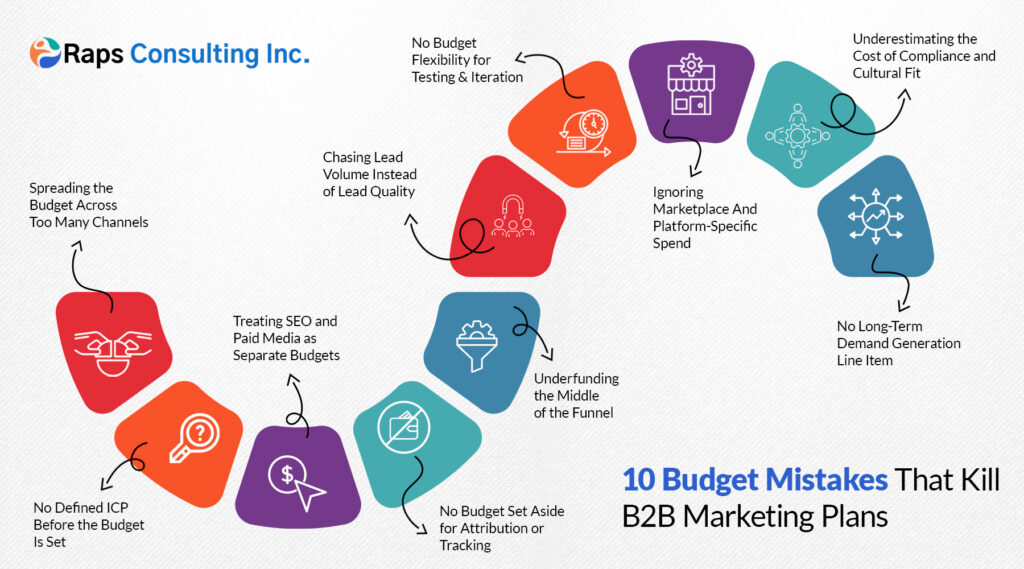
Table of Contents
- Spreading the Budget Across Too Many Channels
- No Defined ICP Before the Budget Is Set
- Treating SEO and Paid Media as Separate Budgets
- No Budget Set Aside for Attribution or Tracking
- Underfunding the Middle of the Funnel
- Chasing Lead Volume Instead of Lead Quality
- No Budget Flexibility for Testing and Iteration
- Ignoring Marketplace and Platform-Specific Spend
- Underestimating the Cost of Compliance and Cultural Fit
- No Long-Term Demand Generation Line Item
- The Bottom Line
- FAQ
Every year, B2B companies pour thousands—sometimes millions—into marketing plans that never deliver the pipeline they promised. It’s rare because the team lacks effort or ideas. It’s because the budget was built on the wrong assumptions from day one.
Below are the 10 most common budget mistakes we see derailing B2B marketing plans, and what to do instead.
Spreading the Budget Across Too Many Channels
Trying to “be everywhere”—SEO, paid social, email, events, ABM, content, PR—sounds thorough, but it usually means every channel is underfunded, and none of them get enough spend or time to prove out.
Fix: Pick 2–3 channels your ICP actually uses, fund them properly, and expand only after they’re producing predictable results.
No Defined ICP Before the Budget Is Set
A lot of B2B budgets get built around a vague “who might buy this” instead of a clearly defined Ideal Customer Profile. Without that, spend gets wasted reaching people who were never going to convert.
Fix: Nail down firmographics, buying triggers, and decision-maker roles before a single dollar is allocated. This is the first step in any solid demand generation strategy—market research before campaign setup, not after.
Treating SEO and Paid Media as Separate Budgets
Many B2B teams fund SEO and paid ads out of completely different buckets, run by different people, with no shared strategy. The result: paid campaigns target keywords SEO is already ranking for, and organic content ignores what paid data shows is actually converting.
Fix: Run SEO and pay as one integrated budget line, sharing keyword and conversion data both ways.
No Budget Set Aside for Attribution or Tracking
It’s common to see 100% of a marketing budget go toward campaigns and 0% toward the tools or setup needed to track what’s actually working. Six months later, no one can say which channel drove which deal.
Fix: Budget for CRM integration and attribution tracking (HubSpot, Salesforce, or similar) from the start—not as an afterthought once leadership starts asking for ROI numbers.
Underfunding the Middle of the Funnel
Most B2B budgets over-invest in top-of-funnel awareness and under-invest in nurturing—the emails, retargeting, and content that turn a lead into a sales-qualified opportunity. Leads come in, then go cold.
Fix: Budget specifically for nurture sequences and lead-scoring workflows, not just for lead generation.
Chasing Lead Volume Instead of Lead Quality
A budget built around “how many leads can we get” instead of “how many qualified leads can we get” leads to bloated top-of-funnel numbers that make marketing look busy but never translate into pipeline.
Fix: Set budget targets around MQL-to-SQL conversion rates, not raw lead counts.
No Budget Flexibility for Testing and Iteration
Locking 100% of a budget into a single campaign plan for the whole quarter leaves no room to shift spend toward what’s working—or away from what isn’t.
Fix: Reserve 10–15% of the budget specifically for testing and reallocating mid-quarter based on real performance data.
Ignoring Marketplace and Platform-Specific Spend
B2B companies selling through marketplaces or platforms often budget for “marketing” in general but ignore the platform-specific tactics (Amazon, industry marketplaces, partner ecosystems) that drive a meaningful share of B2B purchasing today.
Fix: If any revenue comes through a marketplace, it needs its own line item—not leftover spend from the general marketing budget.
Underestimating the Cost of Compliance and Cultural Fit
For B2B companies selling into healthcare, finance, government, or other regulated industries, marketing content that isn’t reviewed for compliance can create expensive problems—or simply never get approved to run at all, wasting the spend behind it.
Fix: Build compliance review time and cost into the budget and campaign timeline from the start, especially for regulated industries.
No Long-Term Demand Generation Line Item
The biggest mistake: budgeting only for short-term lead generation campaigns and never for demand generation—the ongoing work of staying visible and trusted with buyers who aren’t ready to purchase yet. When the short-term campaigns end, the pipeline dries up with them.
Fix: Treat demand generation as a permanent budget line, not a campaign that starts and stops. Consistent growth comes from consistent demand, not sporadic pushes.
The Bottom Line
Most B2B marketing plans don’t fail because the ideas were bad—they fail because the budget wasn’t built to support them. Fixing these 10 mistakes usually matters more than adding more spend.
RAPS helps B2B companies build integrated marketing budgets—spanning SEO, demand generation, and marketplace marketing—backed by attribution models that show exactly which channels are driving pipeline and revenue, not just clicks.
Explore our Demand Generation services or talk to an expert to see where your current budget may be leaking value.
FAQ
How much should a B2B company budget for marketing?
It varies by industry and growth stage, but most B2B companies allocate somewhere between 6–12% of revenue to marketing, with more aggressive growth targets pushing that higher.
What’s the biggest budget mistake B2B companies make?
Treating marketing as a series of short-term campaigns instead of funding consistent, long-term demand generation—which is what builds a predictable pipeline over time.
How long does it take to see ROI from a corrected marketing budget?
Early signals like engagement and lead quality typically show up in 1–2 months, with stronger, measurable ROI in 3–6 months as nurture and attribution data mature