IT Staffing vs. IT Consulting: Which Solution Fits Your Business?
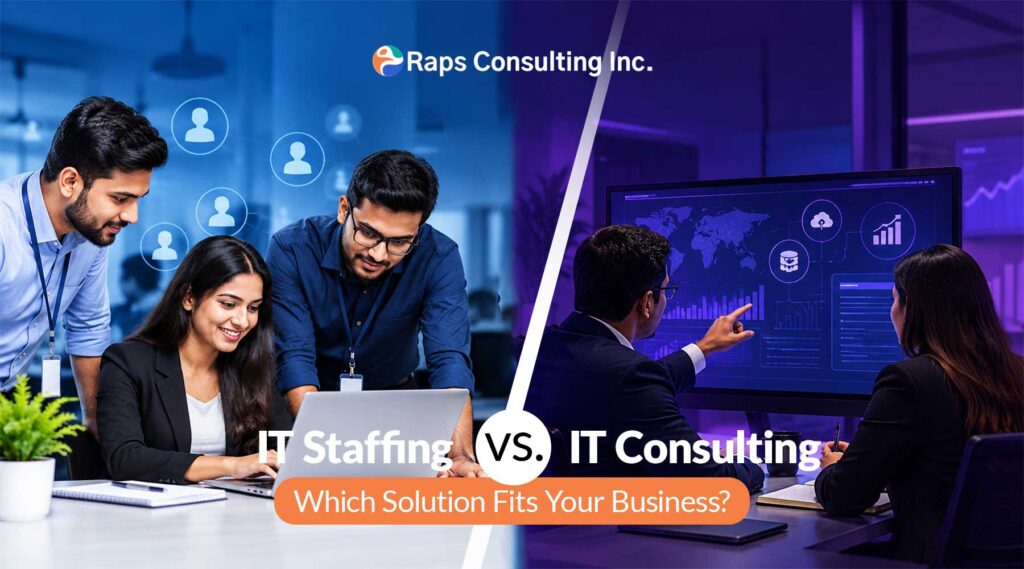
Table of Contents
Your business needs to move an IT project forward, but your internal team cannot handle everything alone. Should you bring in additional professionals or hire consultants to help plan and deliver the work?
Understanding IT staffing vs. IT consulting can help you choose the right approach. IT staffing generally adds professionals to a team your business manages, while IT consulting provides specialist guidance, assessments, or delivery of agreed work.
The right choice depends on your project’s clarity, the expertise available internally, your management capacity, and the outcomes you need to achieve.
What Is IT Staffing?
IT staffing helps businesses find technology professionals for contract, contract-to-hire, or permanent roles. These may include developers, cloud engineers, data analysts, cybersecurity specialists, and QA testers.
When businesses use contract staffing or staff augmentation, external professionals typically work alongside their existing team. Internal managers assign tasks, set priorities, and oversee delivery.
Example: You have an approved application development plan and an experienced technical lead, but need two developers to handle the workload. IT staffing services can help fill those roles while your team retains project control.
Staff augmentation is one form of IT staffing; permanent recruitment is another. For this comparison, the focus is on professionals joining an internally managed team.
What Is IT Consulting?
IT consulting helps businesses assess technology challenges, make decisions, and carry out defined initiatives.
An engagement may cover a systems assessment, cloud migration strategy, application modernization, cybersecurity review, or business software implementation.
Some IT consulting services provide recommendations only. Others include implementation and ongoing assistance. The agreement should specify exactly what the provider will deliver.
Example: Your business uses disconnected applications that create duplicate work and inconsistent reports. A consulting team can assess the systems, recommend an integration approach, and implement it if that work is included in the scope.
IT Staffing vs. IT Consulting: Key Differences
| Factor | IT staffing / staff augmentation | IT consulting |
| Main purpose | Add skills and working capacity | Assess problems, guide decisions, or deliver defined work |
| Best starting point | You know which roles you need | You need specialist input on the approach or delivery |
| Daily management | Your internal team generally directs the work | Responsibilities depend on the engagement |
| Scope | Roles, skills, hours, and assignments | Objectives, deliverables, and acceptance criteria |
| Common pricing | Time-based rates | Time-based fees, retainers, or fixed project fees |
| Project responsibility | Usually remains with your organization | Provider responsibility covers agreed deliverables |
The service name alone does not establish accountability. Review who manages the work, approves decisions, and accepts completed deliverables.
When Should You Choose IT Staffing?
IT staffing is usually a good fit when your business has a clear plan and needs people to execute it.
Consider this approach when:
- Your team is stretched: Existing employees cannot comfortably handle the planned workload.
- You need a specific skill: A project requires expertise your team currently lacks.
- The requirement is temporary: A release or implementation phase needs additional capacity.
- You have internal leadership: Someone can onboard professionals, assign work, and review quality.
For example, an internal analytics team may need a Power BI developer to build reports against approved requirements.
Before engaging an IT staffing agency, confirm that your managers have the time and knowledge to support the added professionals. More people will not automatically solve unclear requirements or delayed decisions.
When Should You Choose IT Consulting?
IT consulting is often suitable when the challenge requires specialist judgment or your business needs help defining and delivering a solution.
Consider this approach when:
- The underlying problem is unclear: You see recurring failures or inefficiencies but do not know their cause.
- You face a significant technology decision: You need to evaluate platforms, architecture, or migration options.
- Your team lacks relevant project experience: Employees understand current operations but need expertise for a new initiative.
- You need defined outputs: The engagement must produce an assessment, roadmap, design, or implemented solution.
For example, a business preparing to migrate applications to the cloud may need an assessment of dependencies, security requirements, and migration priorities before implementation begins.
Consulting still requires an internal owner who can provide business context and make timely decisions.
Which Option Is More Cost-Effective?
Neither model is automatically cheaper. Compare the total effort required to achieve your objective.
With IT staffing, costs include the professionals’ time and your team’s effort in onboarding, supervision, coordination, and quality review.
With IT consulting, check whether the fee covers discovery, implementation, testing, documentation, training, and post-launch support. Clarify how changes to the scope will be charged.
Staffing may fit when your team can lead the work effectively. Consulting may be more appropriate when decisions or delivery methods need specialist input.
A lower hourly rate does not necessarily mean a lower total project cost.
Can You Combine IT Staffing and IT Consulting?
Yes. A project can require both a clear technical approach and additional delivery capacity.
For an application modernization initiative, consultants might assess the existing system and define the architecture. Staffed developers and testers could then work under internal leadership to carry out the agreed plan.
The important step is assigning ownership. Establish who makes technical decisions, manages tasks, approves changes, and signs off on completed work.
How to Choose the Right Approach
Before speaking with a provider, answer four questions:
- What is missing? Additional people, specialist guidance, or both?
- How clear is the work? Are requirements established, or is discovery needed?
- Who will lead delivery? Do you have the management capacity internally?
- What must remain after the engagement? Define documentation, knowledge transfer, and support needs.
These answers will help you compare providers against your actual requirements.
At RAPS Consulting, we support businesses through IT staffing and IT consulting services. Whether you need professionals to strengthen your team or expertise for a technology initiative, we can help you explore an approach that fits your needs.
Connect with RAPS Consulting to discuss your project and the support your team needs.