5 Startup Hiring Challenges and How to Solve Them
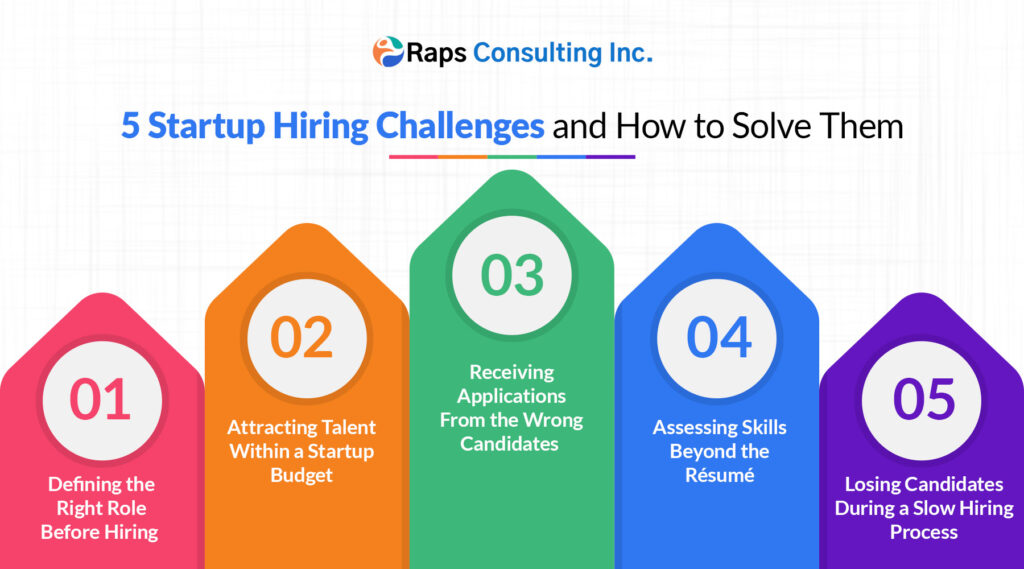
Table of Contents
Your next hire should take work off your plate. But first, you need to know which work.
For early-stage founders, startup hiring challenges often begin when deadlines pile up and the team cannot keep pace. Rushing to fill that gap can lead to unclear roles, unsuitable applications, and employees who need different support than expected.
The most common startup hiring challenges involve role clarity, limited budgets, candidate quality, skill assessment, slow decisions, workplace expectations, and onboarding.
Here’s how to identify each problem and take a practical next step.
1. Defining the Right Role: A Common Startup Hiring Challenge
A startup may advertise for a marketing manager when its immediate need is someone to build landing pages and run campaigns. The title sounds right, but the responsibilities require a different skill set.
Without a clear role, both screening and performance expectations become difficult.
How to solve it
List the tasks slowing your business down. Group related responsibilities, then define three outcomes the employee should deliver within their first 90 days.
For example:
- Launch two campaign landing pages.
- Set up lead tracking.
- Establish a weekly campaign report.
Use these outcomes to write the job description and distinguish essential skills from those you can teach.
Takeaway: Hire for a defined business need—not a job title that sounds impressive.
2. Attracting Talent Within a Startup Budget
An experienced candidate may like your business but need compensation you cannot offer. Trying to bridge the gap with vague promises can create disappointment.
How to solve it
Set a realistic compensation range before approaching candidates. Explain the benefits you can genuinely provide, such as flexibility, direct access to leadership, or ownership of meaningful work.
Match the hiring arrangement to the requirement:
| Business need | Arrangement to consider |
| Ongoing responsibility central to operations | Full-time employee |
| Defined project with a clear completion point | Project-based specialist support |
| Temporary workload increase | Contract staffing |
Make responsibilities, payment terms, and expectations clear before moving forward.
Takeaway: A realistic hiring plan starts with an honest budget.
3. Receiving Applications From the Wrong Candidates
If most applicants lack the skills you need, more applications will not solve the problem. Your job description or sourcing channels may need attention.
How to solve it
Replace broad phrases such as “wear many hats” with specific responsibilities. State the essential skills, working arrangements, and expected outcomes.
For example, replace:
“Looking for a passionate sales professional.”
With:
“Looking for someone who can prospect small-business accounts, conduct discovery calls, and maintain an accurate sales pipeline.”
Share the role through relevant professional communities, targeted outreach, and suitable recruitment partners. Track which channels produce qualified candidates.
Takeaway: Measure the quality of your shortlist, not the size of your inbox.
4. Assessing Skills Beyond the Résumé
Founders can struggle to evaluate candidates outside their expertise. A confident explanation of software development or paid advertising may sound convincing without demonstrating practical ability.
How to solve it
Use a consistent assessment based on the actual work:
- Ask each candidate the same core interview questions.
- Include a short, relevant work sample.
- Ask them to explain their decisions and assumptions.
- Use a simple scorecard to compare responses.
For technical positions, involve a qualified evaluator. Keep assignments proportionate and avoid asking candidates to complete usable client work for free.
Takeaway: Ask candidates to show how they think—not just describe what they know.
5 Losing Candidates During a Slow Hiring Process
When recruitment competes with customer calls and product deadlines, interviews get postponed. Candidates may accept another offer before your team reaches a decision.
How to solve it
Agree on the process before the first interview:
- Who reviews applications?
- Which interview stages are necessary?
- Who makes the final decision?
- When will candidates receive an update?
Reserve interview time and collect feedback promptly. If plans change, communicate the delay.
A shared tracker can be enough for a small hiring team, provided someone owns the next action.
Addressing these startup hiring challenges early can help founders build a stronger team and avoid costly recruitment mistakes.
Takeaway: Every candidate should know what happens next.
Frequently Asked Questions About Hiring for Startups
How do I decide whom to hire first?
Identify the work most directly affecting delivery, customers, or business progress. Prioritize a role with clear responsibilities and enough ongoing work to justify the investment.
How can a startup attract employees without a large salary budget?
Be transparent about pay and offer genuine advantages where possible, such as flexibility, meaningful responsibility, and development opportunities. Keep expectations aligned with the compensation available.
When should a startup use a recruitment agency?
Consider recruitment support when suitable candidates are difficult to find, specialist skills are hard to assess, or hiring is taking significant time away from running the business. Agree on the scope, fees, and selection process first.
Make Your Next Hire a More Informed Decision
Before advertising a vacancy, finish this sentence:
“Within 90 days, this person will help our business achieve ______.”
A clear answer helps you overcome startup hiring challenges and gives your recruitment process direction—from the job description through interviews and onboarding.
RAPS Professional Services helps businesses find talent across technical and professional roles.
Share your requirements with our team to discuss staffing support for your startup.