How IT Outsourcing Helps Businesses Access Expertise and Scale
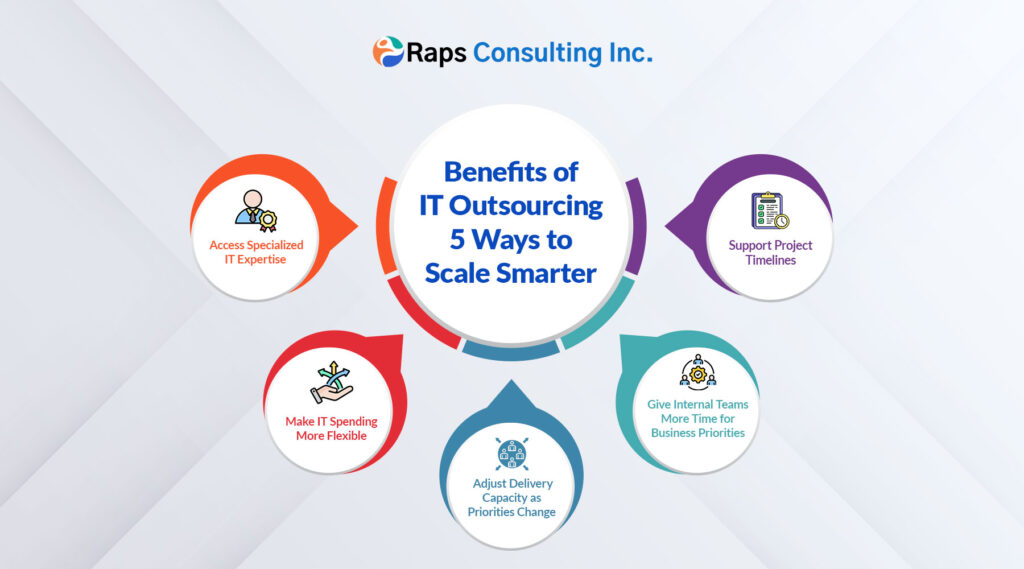
Table of Contents
Your business is ready to improve an application, connect its systems, or move a project forward. Your IT team, however, is already balancing support requests, maintenance, and existing commitments.
Should you hire more employees, delay the project, or bring in an external partner?
Understanding the benefits of IT outsourcing can help you make that decision. Beyond potential cost flexibility, the right arrangement can give your business access to specialized skills, additional delivery capacity, and support for important technology improvements.
The value depends on what you outsource, who manages the work, and how clearly you define success. Here are five potential advantages and the questions worth asking before you commit.
What Is IT Outsourcing?
IT outsourcing means engaging an external provider to deliver defined technology services, projects, or functions. Depending on the agreement, this could include application development, cloud migration, system integration, software testing, or ongoing support.
It does not require handing over your entire IT operation. You might outsource one project while your internal team retains responsibility for architecture, priorities, and business decisions.
It also differs from IT staff augmentation. With staff augmentation, external professionals generally work under your team’s direction. In a project or managed-service outsourcing arrangement, the provider takes responsibility for agreed deliverables or services. The contract should make that distinction clear.
1. Access Specialized IT Expertise
A capable internal team may still need additional expertise for a particular initiative. For example, maintaining existing applications requires a different mix of experience from planning a cloud migration or connecting an ERP platform to other business systems.
One of the benefits of outsourcing IT services is the ability to engage skills for a defined need without creating a permanent role for every requirement.
2. Make IT Spending More Flexible
Outsourcing can provide different ways to structure spending, such as an agreed project fee, a monthly service arrangement, or time-based billing. Each model suits different levels of scope and uncertainty.
For a limited initiative, an external engagement may be more practical than building a permanent team around a temporary workload. However, a lower quoted rate does not automatically mean a lower total cost.
Include onboarding, transition, licenses, internal oversight, change requests, and eventual handover in your comparison.
3. Adjust Delivery Capacity as Priorities Change
Technology workloads rarely remain constant. A product release, new integration, or business expansion may require more capacity than routine operations.
An outsourcing arrangement can let you add capacity for an agreed period or phase of work. That flexibility is useful when the business need is clear but the long-term staffing requirement is uncertain.
Capacity changes still require planning. New contributors need access, documentation, and time to understand your systems.
4. Give Internal Teams More Time for Business Priorities
When every request reaches the same small group, strategic work can compete with routine delivery tasks. Outsourcing selected activities can give internal employees more room to focus on architecture, stakeholder needs, and the systems that distinguish your business.
For example, a business could assign a defined application enhancement to an external team while internal leaders retain ownership of product priorities and acceptance decisions.
5. Support Project Timelines
A project may stall because the right skills or available capacity are missing. An external team can help address those constraints when its experience and availability match the work.
This is especially useful when a clearly defined project is competing with ongoing operational responsibilities. It gives the business another delivery option rather than leaving the initiative in a growing backlog.
Faster delivery is not guaranteed. Unclear requirements, slow approvals, and unresolved dependencies can delay outsourced projects too.
When Does IT Outsourcing Make Sense?
IT outsourcing is worth evaluating when you have a specific skills gap, a temporary increase in workload, a defined project, or an ongoing service that can be described and measured clearly.
It may be less suitable when requirements remain unsettled, nobody internally can own decisions, or restrictions prevent a provider from accessing the systems needed for delivery. In those situations, clarifying the operating model may be the first step.
For some businesses, a combined approach works well: an internal team retains strategy and ownership while an external partner handles selected delivery responsibilities.
How to Choose an IT Outsourcing Partner
Before comparing proposals, write down the problem, desired outcome, scope, and constraints. Then evaluate providers against the same questions:
- Relevant experience: Have they completed work involving comparable systems and requirements?
- Delivery ownership: Who manages the team, makes decisions, and accepts completed work?
- Communication: How will progress, risks, and changes be reported?
- Commercial clarity: What is included, excluded, and chargeable as additional work?
- Security: How will access, data handling, and incident notification be managed?
- Continuity: What documentation, knowledge transfer, and exit support will you receive?
A useful proposal should explain how the provider will work with your business, not simply list technologies or hourly rates.
Discuss Your IT Priorities with RAPS Consulting
The benefits of IT outsourcing are most meaningful when they address a clearly defined business need. Start with the outcome you want, then decide which skills, delivery responsibilities, and resources should sit with your internal team or an external partner.
RAPS Consulting helps businesses explore IT staffing and technology support options based on their requirements and project priorities.
Whether you need additional IT professionals or support for a technology initiative, connect with RAPS Consulting to discuss your goals, scope, and next steps.
Frequently Asked Questions
What are the main benefits of IT outsourcing?
Potential benefits include access to specialized skills, flexible spending, additional delivery capacity, more time for internal priorities, project support, security expertise, and modernization support. Results depend on the provider, scope, and how the engagement is managed.
Is IT outsourcing always cheaper than hiring internally?
No. Compare total costs, including transition, oversight, licenses, changes, and handover. A permanent internal role may be more suitable for continuing work that depends heavily on business-specific knowledge.
What is the difference between IT outsourcing and staff augmentation?
Staff augmentation adds professionals who generally work under your team’s management. IT outsourcing assigns responsibility for defined deliverables or services to a provider, subject to the agreement.
Can a business outsource only part of its IT work?
Yes. A business can engage a provider for a specific project or function while retaining other responsibilities internally. Define ownership and handoffs so both teams understand their roles.