


What an AI-Ready Business Infrastructure Actually Looks Like 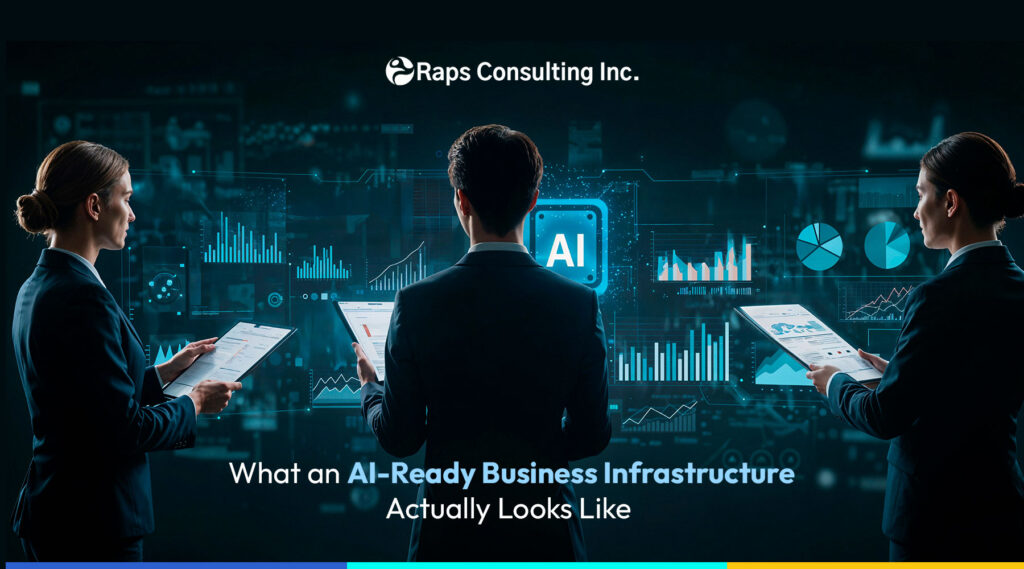
What an AI-Ready Business Infrastructure Actually Looks Like
Artificial intelligence is no longer a future investment reserved for large tech companies. Businesses across industries are now exploring AI to automate operations, improve customer experiences, reduce costs, and make faster decisions.
But there is one major challenge most organizations overlook:
AI is only as effective as the infrastructure supporting it.
Many companies rush into AI tools without realizing their systems, workflows, and data environments were never designed for intelligent automation. The result is fragmented deployments, poor adoption, unreliable outputs, and expensive experimentation with little measurable value.
An AI-ready business infrastructure is not simply about purchasing AI software. It is about building the digital foundation that allows AI technologies to work efficiently, securely, and at scale.
In this article, we will break down what an AI-ready infrastructure actually looks like, why it matters, and how businesses can prepare for long-term AI transformation.
Why AI Readiness Has Become a Business Priority
AI adoption is accelerating across nearly every sector. From predictive analytics and customer support automation to workflow optimization and intelligent reporting, businesses are using AI to improve operational efficiency and decision-making.
However, many organizations quickly discover that legacy systems create barriers to AI implementation.
Common challenges include:
- Data stored across disconnected systems
- Outdated on-premise infrastructure
- Limited cloud scalability
- Poor integration between business applications
- Inconsistent data quality
- Security and compliance concerns
- Manual workflows with no automation foundation
Without addressing these issues, even advanced AI tools struggle to deliver reliable results.
This is why enterprise AI readiness has become a strategic priority rather than just a technology initiative.
What Is an AI-Ready Business Infrastructure?
An AI-ready infrastructure is a connected, scalable, and secure digital ecosystem designed to support AI-driven operations, analytics, and automation.
It allows businesses to:
- Collect and unify data efficiently
- Process information in real time
- Integrate systems across departments
- Automate repetitive tasks
- Scale computing resources when needed
- Maintain security and compliance standards
- Support intelligent decision-making across the organization
Instead of isolated technology upgrades, AI-ready businesses focus on creating a flexible infrastructure that can continuously adapt as AI capabilities evolve.
Core Components of an AI-Ready Infrastructure
- Cloud-Based Infrastructure
Modern AI applications require computing flexibility that traditional servers often cannot provide efficiently.
Cloud infrastructure enables businesses to scale processing power, storage, and services based on demand without maintaining costly physical systems.
Platforms such as Microsoft Azure allow organizations to:
- Deploy AI workloads faster
- Access scalable computing resources
- Improve system reliability
- Support remote and hybrid operations
- Reduce infrastructure maintenance overhead
- Integrate AI services directly into business applications
Cloud environments also make it easier to adopt machine learning, automation, and advanced analytics tools over time.
Businesses still relying heavily on fragmented on-premise systems may face significant limitations when attempting AI transformation initiatives.
- Unified and Accessible Data
AI systems depend heavily on high-quality, accessible data.
If customer records, operational data, reporting systems, and business applications are disconnected, AI tools cannot generate accurate insights.
AI-ready organizations prioritize:
- Centralized data management
- Real-time data synchronization
- Clean and structured datasets
- API-based connectivity
- Cross-department data accessibility
- Data governance standards
This often requires modern data integration strategies that connect ERP systems, CRM platforms, cloud applications, analytics tools, and operational databases into a unified environment.
Without reliable data infrastructure, AI outputs become inconsistent and difficult to trust.
- API and System Integration
Disconnected systems are one of the biggest obstacles to enterprise AI readiness.
AI tools need access to information across multiple business functions including finance, operations, HR, customer support, supply chain, and sales.
This is where API integration becomes critical.
An AI-ready business typically includes:
- Integrated enterprise applications
- Automated data exchange
- Real-time workflow synchronization
- Scalable API architecture
- Secure third-party integrations
Modern integration frameworks allow businesses to eliminate manual data transfers and create connected ecosystems where AI can operate efficiently.
- Automation-First Workflows
AI performs best when built on top of structured digital workflows.
Organizations still dependent on spreadsheets, emails, and manual approvals often struggle to implement AI effectively because processes are inconsistent and difficult to automate.
AI-ready businesses invest in:
- Workflow automation
- Process standardization
- Digital approvals
- Automated notifications
- Intelligent task routing
- Business process optimization
Platforms like Microsoft Power Automate and enterprise workflow systems help create operational consistency that AI tools can later enhance with predictive or intelligent capabilities.
- Cybersecurity and Governance
As AI systems gain access to larger volumes of business data, cybersecurity becomes even more important.
AI-ready infrastructure must include:
- Role-based access controls
- Data encryption
- Identity management
- Compliance monitoring
- Audit logging
- Secure cloud architecture
- Governance policies for AI usage
Businesses handling sensitive customer, healthcare, financial, or operational data must ensure AI deployments align with industry regulations and security best practices.
Without proper governance, AI adoption can increase operational and compliance risks.
- Scalable Analytics and Reporting
AI is not just about automation. It is also about better decision-making.
Organizations need reporting systems capable of turning large amounts of operational data into actionable insights.
AI-ready businesses typically use:
- Real-time dashboards
- Business intelligence platforms
- Predictive analytics tools
- Data visualization systems
- KPI monitoring environments
Solutions like Microsoft Power BI help organizations centralize reporting while enabling leadership teams to make faster, data-driven decisions.
Strong analytics infrastructure also creates the foundation for future AI-driven forecasting and decision support systems.
Signs Your Business May Not Be AI-Ready Yet
Many organizations are excited about AI but still lack the infrastructure required to support it effectively.
Common warning signs include:
- Heavy reliance on spreadsheets
- Siloed business applications
- Manual reporting processes
- Limited cloud adoption
- Poor system integration
- Inconsistent operational data
- Lack of automation workflows
- Difficulty accessing real-time insights
- Frequent data duplication issues
- Security concerns around data sharing
These challenges do not mean AI transformation is impossible. They simply indicate that infrastructure modernization should happen before large-scale AI deployment.
The Business Benefits of Becoming AI-Ready
Organizations that invest in AI-ready infrastructure position themselves for long-term operational advantages.
Key benefits include:
Faster Decision-Making
Connected data and real-time reporting improve visibility across operations.
Greater Operational Efficiency
Automation reduces repetitive manual work and improves productivity.
Improved Scalability
Cloud-based systems allow businesses to adapt quickly as demands grow.
Better Customer Experiences
Integrated systems create faster, more personalized customer interactions.
Reduced Technology Fragmentation
Modern infrastructure simplifies system management and improves interoperability.
Stronger Competitive Positioning
Businesses prepared for AI adoption can innovate faster than competitors still relying on outdated systems.
AI Transformation Is More About Strategy Than Software
One of the biggest misconceptions surrounding AI is that transformation starts with buying AI tools.
In reality, successful AI adoption begins with infrastructure readiness.
Businesses that see long-term value from AI typically focus first on:
- Modernizing systems
- Improving data quality
- Building cloud infrastructure
- Automating workflows
- Strengthening integrations
- Enhancing security and governance
Only after these foundations are established can AI technologies deliver scalable and measurable business outcomes.
Final Thoughts
AI is rapidly becoming part of modern business operations, but sustainable AI transformation requires far more than experimenting with new software.
An AI-ready business infrastructure is built on connected systems, reliable data, scalable cloud environments, automation, cybersecurity, and analytics.
Organizations that invest in these foundational capabilities today will be far better positioned to adopt AI successfully in the future.
Instead of asking whether your business should use AI, the more important question may be:
Is your infrastructure ready for it?
FAQs
What does AI-ready infrastructure mean?
AI-ready infrastructure refers to the systems, cloud environments, integrations, data architecture, and security frameworks needed to support AI applications effectively within a business.
Why is cloud infrastructure important for AI?
Cloud infrastructure provides the scalability, computing power, flexibility, and integration capabilities needed to run modern AI workloads efficiently.
Can businesses use AI without modernizing infrastructure?
Some businesses can implement limited AI tools without full modernization, but outdated infrastructure often reduces AI effectiveness, scalability, and accuracy.
What are the first steps toward enterprise AI readiness?
The first steps usually include improving data quality, modernizing cloud infrastructure, integrating business systems, and automating manual workflows.
How does automation support AI transformation?
Automation creates structured digital workflows that allow AI systems to analyze, optimize, and improve operational processes more effectively.