


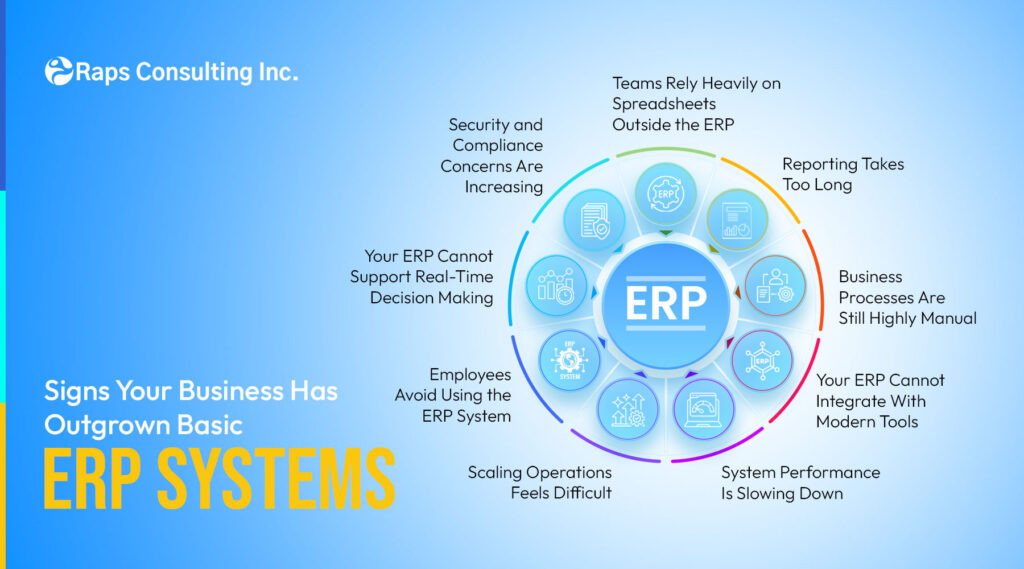
Signs Your Business Has Outgrown Basic ERP Systems
As businesses grow, the systems that once supported operations efficiently can eventually become barriers to scalability, productivity, and decision-making. Many organizations continue using outdated or basic ERP systems long after their operational needs have evolved, leading to inefficiencies that quietly impact growth.
An Enterprise Resource Planning (ERP) system is meant to centralize business operations, streamline workflows, and improve visibility across departments. However, when the system can no longer keep up with increasing complexity, it creates operational bottlenecks instead of solving them.
Recognizing the warning signs early can help organizations avoid larger performance, financial, and operational challenges down the road.
What Happens When an ERP System No Longer Fits the Business?
Basic ERP systems often work well during early business growth. But as organizations expand, they experience:
- More users
- Larger data volumes
- Additional departments
- Complex reporting needs
- Multi-location operations
- Increased compliance requirements
- Greater customer expectations
When ERP systems fail to scale, teams rely on manual workarounds and disconnected tools, reducing efficiency and decision-making speed.
Signs Your ERP System Needs Modernization
1. Heavy Dependence on Spreadsheets
If employees rely on Excel for reporting, forecasting, or inventory tracking, your ERP is likely outdated.
- Duplicate data handling
- Human errors
- Version control issues
- Delayed reporting
2. Slow Reporting and Poor Visibility
Delayed reports and inconsistent metrics indicate the need for a modern ERP system.
- Real-time dashboards
- Automated reporting
- Advanced analytics
3. Manual Business Processes
Repetitive manual tasks reduce productivity and increase errors.
- Manual invoice approvals
- Email-based workflows
- Spreadsheet-driven tracking
4. Poor Integration with Modern Tools
Older ERP systems often fail to integrate with CRM, HR, or cloud tools.
- Data silos
- Inconsistent information
- Fragmented workflows
5. Performance Issues
Slow systems, crashes, and downtime directly affect productivity.
- Slow loading times
- System crashes
- Delayed transactions
6. Difficult Business Scaling
If growth creates operational chaos, your ERP is not scalable enough.
- Onboarding issues
- Multi-location reporting problems
- Limited customization
7. Low User Adoption
If employees avoid using the ERP system, it is likely inefficient or difficult to use.
- Email dependency
- Offline spreadsheets
- Manual processes
8. No Real-Time Decision Support
Outdated systems limit analytics and forecasting capabilities.
- Static reports
- Delayed data
- Limited KPIs
9. Security and Compliance Risks
Legacy ERP systems increase vulnerability to cyber threats and compliance gaps.
- Weak access controls
- No audit tracking
- Security risks
Why ERP Modernization Matters
Modern ERP systems help businesses achieve:
- Improved operational visibility
- Automation of workflows
- Faster reporting and insights
- Better collaboration
- Stronger scalability
- Reduced manual work
ERP modernization is not just software upgrade—it is a long-term business transformation strategy.
Conclusion
Outdated ERP systems can slow down business growth and reduce efficiency. If your organization faces manual processes, slow reporting, or integration issues, it may be time for modernization.
Modern ERP solutions enable automation, scalability, and real-time decision-making—helping businesses stay competitive in a fast-changing environment.
Frequently Asked Questions (FAQs)
What is ERP modernization?
ERP modernization is upgrading outdated systems to improve automation, scalability, integration, and performance.
How do I know if my ERP is outdated?
Signs include spreadsheet dependency, slow reporting, manual workflows, and poor system performance.
What are the benefits of ERP modernization?
It improves efficiency, automation, data visibility, security, and scalability.
Can ERP systems automate business processes?
Yes, modern ERP systems automate approvals, procurement, HR, finance, and more.
Why move to cloud ERP?
Cloud ERP offers better scalability, security, remote access, and lower infrastructure management costs.